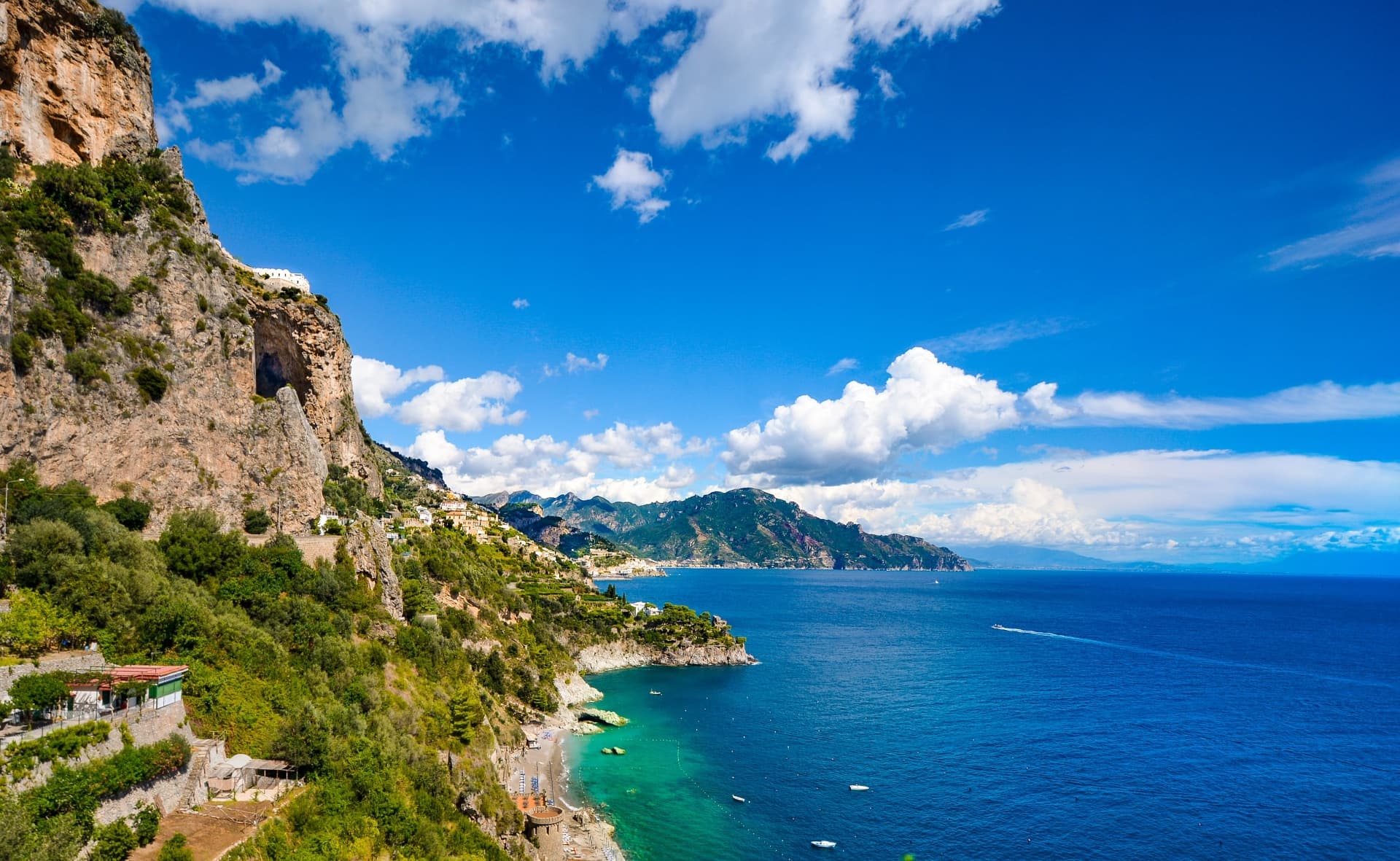
Private transfers in Campania
Connect any place in Campania to any other with a private driver: a fixed price agreed before you leave, door-to-door service, no connections to catch. Pick your origin, pick your destination, see the price straight away.
Choose your route- 27
- places served
- 702
- routes available
- 100%
- fixed price, confirmed before you book
Where are you going?
Getting around Campania looks simple on a map and is far less so on the ground: the Amalfi Coast has no railway station, Positano can only be reached by road, and the Circumvesuviana train to Sorrento is packed — an obstacle course once you add luggage. Journeys that look short on the map turn into two changes and an hour of waiting.
A private transfer removes the problem at the root. Your driver waits where you are, loads the bags and takes you exactly where you need to go, with no intermediate stops and no timetable but your own. The price is agreed beforehand: what you read is what you pay, traffic and delays included.
How it works
Three steps, no surprises.
- 1
Choose origin and destination
Every place connects to every other. Select the two points and open the route page: you get the distance, the estimated duration and an indicative price per car.
- 2
Request confirmation
Send us the date, time and number of passengers. We reply with the final price in writing, including tolls, VAT and the driver.
- 3
We meet you there
Your driver arrives at the agreed point with a sign bearing your name. Flights and trains are tracked: if you run late, pickup shifts at no cost.
Every place we serve
Choose your pickup or drop-off point: each card opens the full list of routes to and from that place.
Naples and arrival hubs
Airport, central station, port and city centre: where almost every trip in Campania begins.
Naples Capodichino Airport
Capodichino · NAPCapodichino is Campania’s only airport and the starting point of most trips in the region.
Naples Central Station
Piazza GaribaldiNapoli Centrale is the terminus of high-speed trains from Rome, Florence and Milan, and the hub from which every regional connection branches out.
Naples city centre
UNESCO old townNaples is a city you cross on foot but reach by car: the historic centre is a UNESCO site, the alleys are narrow and a restricted traffic zone covers much of the monumental area.
Port of Naples — Molo Beverello
Hydrofoils and cruise shipsNaples’ port is where hydrofoils leave for Capri, Ischia and Procida and where cruise ships dock at the Stazione Marittima.
Molo Luise — Port of Naples
Private yacht berthMolo Luise is the private berth inside the port of Naples: yachts and superyachts moor here, and tenders come ashore from boats lying at anchor.
Pozzuoli and the Phlegraean Fields
Phlegraean Fields · SolfataraPozzuoli is the heart of the Phlegraean Fields, the volcanic area west of Naples with the Flavian Amphitheatre, the Rione Terra and still-active craters.
Vesuvius area and archaeology
Pompeii, Herculaneum and the coastal strip at the foot of Vesuvius, half an hour from Naples.
Herculaneum
Excavations and the Vesuvius roadHerculaneum holds the best-preserved Roman town in Italy: smaller than Pompeii but with timber, fabric and upper floors still intact, sealed under eighteen metres of volcanic mud.
Pompeii
Italy’s most visited archaeological sitePompeii is Italy’s most visited archaeological site: 44 hectares of Roman city frozen by the AD 79 eruption.
Castellammare di Stabia
Roman villas and Monte FaitoCastellammare di Stabia is the gateway to the Sorrentine peninsula: the motorway ends here and the coastal road around the gulf begins.
Marina di Stabia — Castellammare di Stabia
Marina on the Gulf of NaplesMarina di Stabia is one of the largest marinas on the Gulf of Naples: a sheltered basin at the foot of Monte Faito, with pontoons for boats of every size and full services ashore.
Sorrentine peninsula
Sorrento and the villages overlooking the gulf, gateway to Capri and the Amalfi Coast.
Vico Equense
Terraces over the gulfVico Equense is the first village on the Sorrentine peninsula coming from Naples: a town on a tuff spur above the sea, famous for pizza by the metre and for the beaches of Marina di Equa and Marina di Vico.
Sorrento
The ideal base for Capri and the CoastSorrento is the most practical base on the gulf: hydrofoils to Capri leave from here, as does the coast road to Amalfi and the Circumvesuviana train to Pompeii.
Amalfi Coast
Positano, Amalfi, Ravello and the villages along the SS163: narrow roads where a private car makes the difference.
Positano
The Coast’s vertical villagePositano is built vertically into a rock amphitheatre: pastel houses, staircases and a single one-way road descending to the beach.
Praiano
Sunsets and the Fiordo di FurorePraiano is the Amalfi Coast without the crowds: a fishing village between Positano and Amalfi, with the San Gennaro square looking out to sea and the path down to Gavitella beach, the only one on the coast facing the sunset.
Amalfi
The ancient Maritime RepublicAmalfi gives the whole coast its name and is the only village with a real square and a harbour: the Cathedral of Sant’Andrea and its great staircase dominate the centre, while behind it opens the Valle dei Mulini with its old paper mills.
Ravello
Gardens 350 metres above the seaRavello sits 350 metres above the coast, reachable only by a hairpin road climbing from Atrani.
Maiori
The Coast’s longest beachMaiori has the longest shoreline on the Amalfi Coast — almost a kilometre of sand — and a flat seafront promenade, a rarity around here.
Minori
Roman villa and capital of tasteMinori is the quietest village on the eastern stretch of the Coast, with a first-century Roman maritime villa steps from the beach and a pastry tradition that makes it a fixed stop for anyone travelling with their palate.
Vietri sul Mare
Gateway to the Coast, home of ceramicsVietri sul Mare is the first village on the Coast coming from Salerno, and the easiest to reach: the SS163 begins here and the bends are not yet the impossible ones of Positano.
Salerno and Cilento
Costa d’Amalfi airport, Salerno, the temples of Paestum and the Cilento coast, south of the Amalfi Coast.
Salerno Costa d’Amalfi Airport
Pontecagnano · QSRSalerno Costa d’Amalfi airport, at Pontecagnano, is the closest gateway to southern Campania: Salerno is about twenty minutes away, Paestum around half an hour, the Amalfi Coast just under an hour.
Salerno
Port, high-speed rail and seafrontSalerno is the second gateway to the Amalfi Coast: it has a high-speed rail station, a port with seasonal ferries to Amalfi and Positano, and one of the finest seafront promenades in southern Italy.
Marina d’Arechi — Salerno marina
Salerno’s marinaMarina d’Arechi is Salerno’s marina: an artificial island linked to the shore by a bridge, designed by Santiago Calatrava, with berths up to large yachts.
Paestum
Greek temples and buffalo mozzarellaPaestum preserves three Doric temples from the 5th century BC among the best preserved anywhere — more intact than many in Greece.
Agropoli
Gateway to the CilentoAgropoli is the gateway to the Cilento National Park: a medieval village on a headland, with the Aragonese castle at the top and long beaches running south.
Inland and long distance
The Royal Palace of Caserta and direct connections with Rome and Fiumicino — no changes, no dragging luggage.
Caserta
The Royal Palace and its parkCaserta is home to the Bourbon Royal Palace, the largest royal residence in the world by volume, with a three-kilometre park culminating in the Great Waterfall and the English Garden.
Rome Fiumicino Airport
Leonardo da Vinci · FCOFiumicino is Italy’s main intercontinental gateway and, for many travellers, the real point of arrival for Campania.
Rome
City centre · TerminiRome is the first or the last leg of many trips to Campania.
Most requested routes
The connections our customers book most often, with distance, duration and indicative price.
Naples Airport
Sorrento
52 km · 1h 20
from
€160
Naples Airport
Positano
59 km · 1h 35
from
€175
Naples Airport
Amalfi
69 km · 1h 45
from
€190
Naples Airport
Pompeii
28 km · 30 min
from
€110
Naples Central Station
Sorrento
47 km · 1h 15
from
€150
Naples Central Station
Positano
55 km · 1h 25
from
€165
Naples Airport
Ravello
74 km · 1h 55
from
€200
Naples Airport
Caserta
25 km · 30 min
from
€105
Naples
Pompeii
32 km · 40 min
from
€115
Salerno
Amalfi
27 km · 45 min
from
€175
Sorrento
Positano
17 km · 30 min
from
€160
Rome Fiumicino
Naples
245 km · 2h 55
from
€470
Why choose a private transfer
Fixed price
Agreed before departure and never recalculated: tolls, fuel and VAT are already included.
Door to door
From wherever you are to the exact address of your destination, with no changes or transfers.
Flights and trains tracked
If you land or arrive late, pickup adjusts by itself, with no surcharge.
Mercedes cars and minivans
Sedans for up to 3 passengers and minivans for up to 8 — recent, air-conditioned and fully licensed.
Free child seats
Child seats and boosters available on request, at no extra cost.
English-speaking drivers
They know the region and can suggest stops, timings and viewpoints along the way.
Frequently asked questions
The Campania we drive through
Places along the route and a short drive away.


Can’t find your route?
We cover the whole of Campania plus connections with Rome and the rest of southern Italy. If the combination you need is not listed, ask for a quote: we calculate it on the same basis and confirm it in writing.
Last updated: